
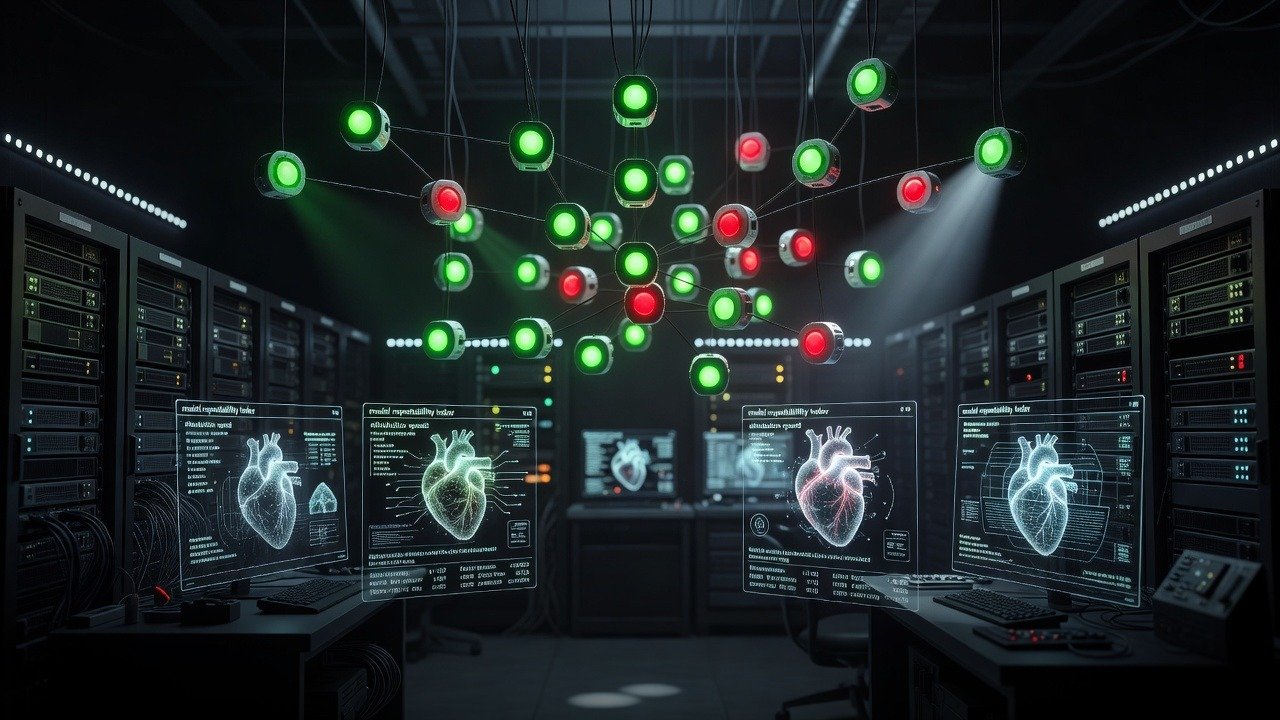
Open Source AI Is Reaching Pediatric Heart Planning
NVIDIA has a clean healthcare AI story here, and it is more interesting than the usual hospital tech demo.
Children’s Hospital of Philadelphia is using open source tools tied to NVIDIA’s medical imaging and simulation stack to turn heart scans into patient-specific 3D models fast enough for clinical planning. The useful part is not that AI is near medicine. The useful part is that a workflow NVIDIA says once took a skilled researcher about four hours can now produce models in seconds.
Quick Take
- Fact: NVIDIA says Children’s Hospital of Philadelphia, or CHOP, has built a cardiac modeling service on MONAI, the open source medical imaging framework cofounded by NVIDIA. The system uses images that care teams already collect, including CT scans, MRI, and 3D ultrasound, to create anatomically precise models of children’s hearts.
- Why it matters: This is a better AI healthcare story than a chatbot slapped onto a patient portal.
The center of gravity is workflow compression. If a clinical team can move from a slow expert-only modeling process to a faster repeatable one, the technology has a plausible path into real operations. It does not replace a surgeon. It gives the team a better map before the p
- Who cares: Hospitals and clinical AI teams should care because this is a credible pattern for adoption: start with a narrow workflow, use existing clinical images, keep specialists in the loop, and make the output concrete enough to inform planning.
- Judgment: Fairly hyped as open source AI making pediatric cardiac modeling faster and more repeatable; overhyped if framed as autonomous AI surgery or proven universal clinical outcome improvement. Fact: NVIDIA reports CHOP us
What happened
NVIDIA says Children’s Hospital of Philadelphia, or CHOP, has built a cardiac modeling service on MONAI, the open source medical imaging framework cofounded by NVIDIA. The system uses images that care teams already collect, including CT scans, MRI, and 3D ultrasound, to create anatomically precise models of children’s hearts.
That matters because congenital heart defects are common enough to be a major care issue, but varied enough to resist simple productization. NVIDIA’s source says about 1% of live births involve a congenital heart defect, and no two cases are exactly alike. A child may need a repair for a hole between the lower chambers of the heart, a valve issue, or another structure that does not match the neat assumptions behind off-the-shelf devices.
The article says CHOP’s work grew from years of research around SlicerHeart, an extension for 3D Slicer, the open source platform used for visualizing, segmenting, and analyzing medical images. CHOP then used MONAI Label and NVIDIA’s Auto3DSeg implementation to train segmentation models on prior image and model pairs.
The operational claim is the key: NVIDIA says models that once required hours at a workstation can now be generated in seconds, with output that meets the same quality standard a trained human would produce.
The source also says the approach is spreading. More than 20 children’s hospitals in the U.S. now run cardiac modeling programs. Boston Children’s Hospital uses modeling in more than half of cardiac surgeries, roughly 500 cases a year. CHOP expects about 200 modeled cases this year.
Why it matters
This is a better AI healthcare story than a chatbot slapped onto a patient portal.
The center of gravity is workflow compression. If a clinical team can move from a slow expert-only modeling process to a faster repeatable one, the technology has a plausible path into real operations. It does not replace a surgeon. It gives the team a better map before the procedure.
The next layer is simulation. NVIDIA says CHOP is working with NVIDIA and the open source community on biomechanics-focused frameworks built with NVIDIA Warp and Newton. Newton is an open source physics engine built on Warp, a Python framework for GPU-accelerated simulation. The goal is to model not just what a heart looks like, but how tissue and devices may interact inside a specific patient.
That is where the promise gets powerful and where the skepticism should stay awake. NVIDIA says GPU acceleration could reduce cardiac device simulation from up to four hours, or an overnight run for multiple configurations, to near real time. In practice, that could let clinicians compare different devices fast enough to support a same-day planning decision.
The phrase to keep in view is could. The source says CHOP has begun implementing Warp and Newton features for closure devices used to seal holes in children’s hearts, with hopes of applying similar methods to transcatheter valve simulations. That is progress, not a blanket claim that real-time simulation is already standard everywhere.
Who should care
Hospitals and clinical AI teams should care because this is a credible pattern for adoption: start with a narrow workflow, use existing clinical images, keep specialists in the loop, and make the output concrete enough to inform planning.
Medical device companies should care because pediatric cardiology is exactly the kind of market where traditional economics can fail. The patient population is smaller and highly heterogeneous, which makes it harder to justify custom commercial tooling for every edge case. Open source collaboration changes the math if hospitals, researchers, philanthropy, and infrastructure companies can share the build burden.
AI builders should care because this is not just another model leaderboard story. It is a stack story: MONAI for medical imaging AI, SlicerHeart for image-based modeling, Warp and Newton for physics simulation, OpenUSD and Omniverse-style digital twin work for 3D interoperability, and possible vision-language model interfaces for querying anatomy in simulation.
Healthcare buyers should care, but with discipline. Company blog claims are not the same as peer-reviewed clinical outcomes. The source gives concrete workflow and adoption details, but buyers still need to ask about validation, quality assurance, clinician review, integration with hospital systems, regulatory posture, audit logs, and liability when a model or simulation is wrong.
Bottom line
The strong read is that open source AI infrastructure is becoming practical enough for specialized clinical planning work. That is a real signal.
The overread is that AI is now solving pediatric heart surgery. It is not. The better framing is narrower and more useful: image segmentation and GPU simulation may turn scarce expert modeling into a more routine planning layer for complex congenital heart cases.
That is the Bandwagon move. Ride the workflow win. Do not sell the miracle.
Bandwagon Check
Fairly hyped as open source AI making pediatric cardiac modeling faster and more repeatable; overhyped if framed as autonomous AI surgery or proven universal clinical outcome improvement. Fact: NVIDIA reports CHOP us
Sources
- Heart of the Matter: How a Major Children’s Hospital Uses Open Source NVIDIA AI for Cardiac Care
- Heart of the Matter: How a Major Children’s Hospital Uses Open Source NVIDIA AI for Cardiac Care
By Sean Smith · AI Bandwagon