
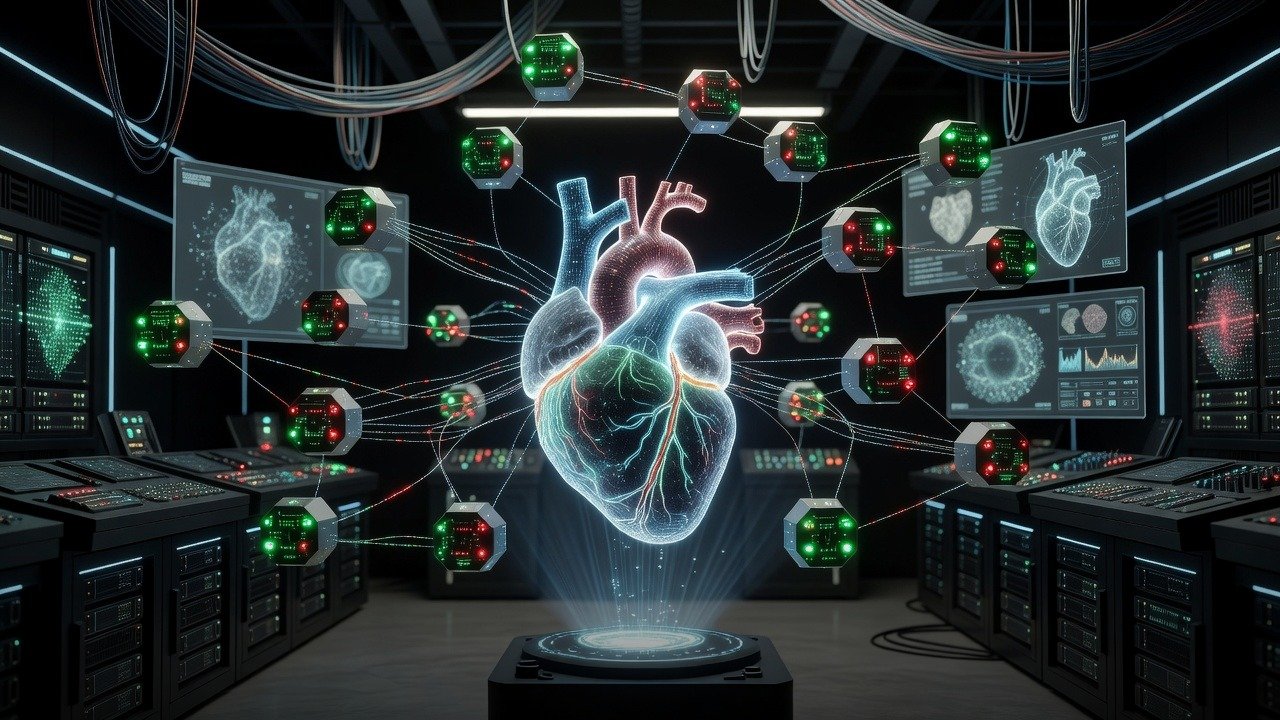
Heart Models in Seconds: CHOP’s Open Source Cardiac AI Stack
Congenital heart care is the kind of problem where “personalized medicine” is not a slogan. A child’s heart anatomy can be tiny, unusual, and hard to map before anyone enters the cath lab or operating room.
Children’s Hospital of Philadelphia is using open source medical AI to make those maps faster. This is the useful healthcare AI lane: narrow workflow, expert review, and a clear time win.
Quick Take
- Fact: Children’s Hospital of Philadelphia, or CHOP, built a cardiac modeling service on MONAI, the open source medical imaging framework cofounded by NVIDIA. In a Sept. 15, 2026 NVIDIA blog post, the company says the system takes scans care teams already collect, including CT, MRI, and 3D ultrasound, and turns them into anatomically precise heart models in seconds.
- Why it matters: This is not a chatbot pasted onto a hospital portal. It is workflow compression.
The scarce resource is expert modeling time. If segmentation can turn hours of manual work into seconds while clinicians stay in control, hospitals can use patient-specific models more often and earlier in planning. The AI is not replacing the surgeon. It is helping the team se
- Who cares: Clinical AI and imaging teams should care because this is a concrete adoption pattern: existing scans, narrow segmentation tasks, specialists reviewing outputs, and models tied to planning decisions.
- Judgment: **Fairly hyped as open source AI making pediatric cardiac modeling faster and more repeatable for clinician-led planning; overhyped if framed as autonomous AI surgery or proven outcome gains across all pediatric heart ca
What happened
Children’s Hospital of Philadelphia, or CHOP, built a cardiac modeling service on MONAI, the open source medical imaging framework cofounded by NVIDIA. In a Sept. 15, 2026 NVIDIA blog post, the company says the system takes scans care teams already collect, including CT, MRI, and 3D ultrasound, and turns them into anatomically precise heart models in seconds.
The time claim is the headline. NVIDIA says a workflow that once required about four hours from a skilled researcher can now finish fast enough for routine clinical use. Using MONAI Label and NVIDIA’s Auto3DSeg implementation, CHOP trained segmentation networks on prior image-and-model pairs. NVIDIA says the output meets the same quality standard a trained human would produce, but in seconds instead of hours.
That matters because pediatric cardiac care is not a template problem. NVIDIA notes that about 1% of live births involve a congenital heart defect, and no two cases are exactly alike. A child may have a hole between the lower chambers of the heart, a leaking valve in a single pumping chamber, or another structure that does not fit neatly with off-the-shelf devices.
Dr. Matthew Jolley, a cardiologist and researcher at CHOP, put the planning problem plainly in NVIDIA’s post: “You’ve got a one-of-a-kind kid and an off-the-shelf device. Our job is to find what fits, and modeling lets us do that before anyone goes into the cath lab or operating room.”
The stack did not appear overnight. Jolley joined CHOP in 2015, when 3D echocardiography was still coming online and tools built for small, complex pediatric anatomy were limited. His lab worked with the open source community on SlicerHeart, an extension of 3D Slicer for visualizing, segmenting, and analyzing 3D medical images. The team then used MONAI Label and Auto3DSeg to train models from earlier scan-and-model pairs.
NVIDIA says the approach is spreading. More than 20 U.S. children’s hospitals now run cardiac modeling programs. Boston Children’s Hospital uses modeling in more than half of cardiac surgeries, roughly 500 cases a year. CHOP expects about 200 modeled cases this year. For complex ventricular septal defects, CHOP now models routinely before surgery.
The post includes one early case that shows the practical value. A child had already undergone two failed repair attempts because surgeons could not locate the defect with traditional methods. A 3D model clarified the anatomy, and the next repair succeeded. That is not proof every modeled case improves outcomes. It is a concrete example of why a better pre-op map can matter.
Why it matters
This is not a chatbot pasted onto a hospital portal. It is workflow compression.
The scarce resource is expert modeling time. If segmentation can turn hours of manual work into seconds while clinicians stay in control, hospitals can use patient-specific models more often and earlier in planning. The AI is not replacing the surgeon. It is helping the team see the specific anatomy before the procedure.
The next layer is simulation. CHOP is working with NVIDIA and the open source community on biomechanics tools using NVIDIA Warp and Newton. Newton is an open source physics engine built on Warp, a Python framework for GPU-accelerated simulation. The goal is to move beyond what the heart looks like and toward how tissue and devices may interact inside a specific patient.
NVIDIA says GPU acceleration could reduce cardiac device simulation from up to four hours, or an overnight run for multiple configurations, toward near real time. CHOP has begun implementing Warp and Newton features for closure devices used to seal holes in children’s hearts, with hopes of extending similar methods to transcatheter valves.
That is promising, but the tense matters. “Could,” “begun,” and “hopes to” are build-path words, not proof that same-day physics simulation is standard everywhere. The segmentation-to-model workflow is the stronger shipped signal. The multi-device simulation layer is still moving from research infrastructure toward clinical workflow.
There is also a real economics angle. NVIDIA cites about 2.4 million people in the U.S. living with congenital heart disease. Jolley’s argument is that the population is too small and too varied for traditional commercial development to solve every need alone. Open source becomes the workaround: SlicerHeart is free to use and extend, Stanford and Boston Children’s contribute tools alongside CHOP, and NVIDIA says a national consortium of children’s hospitals is forming around shared modeling infrastructure.
For builders, the lesson is not “AI fixes healthcare.” It is stack discipline: MONAI for imaging AI, SlicerHeart and 3D Slicer for modeling, Warp and Newton for physics, and clinicians in the loop at every high-stakes step.
Who should care
Clinical AI and imaging teams should care because this is a concrete adoption pattern: existing scans, narrow segmentation tasks, specialists reviewing outputs, and models tied to planning decisions.
Pediatric cardiac programs should care because rare, high-variance anatomy is exactly where shared open tooling can beat isolated one-off builds.
Device companies should care because patient-specific modeling and simulation could change how teams evaluate fit, stress, and deployment risk before a procedure.
AI builders should care because this is a systems story, not a leaderboard story. The useful pieces are labeled data, quality bars, clinical QA, imaging pipelines, and GPU simulation.
Healthcare buyers should care with discipline. A company blog is not an outcomes paper. Ask about validation cohorts, mandatory clinician review, PACS and EHR integration, regulatory posture, audit trails, and liability when a model or simulation is wrong.
Bottom line
CHOP’s work is a strong example of medical AI doing something narrow enough to be useful: making patient-specific cardiac models faster and more repeatable for expert planning.
The overread is that AI is solving pediatric heart surgery. It is not. The better read is that open source imaging AI can reduce modeling time, expand access to patient-specific planning, and create a path toward richer device simulation. One layer is already being used for selected complex work at CHOP. The next layer is still being built.
Ride the workflow win. Do not sell the miracle.
Bandwagon Check
**Fairly hyped as open source AI making pediatric cardiac modeling faster and more repeatable for clinician-led planning; overhyped if framed as autonomous AI surgery or proven outcome gains across all pediatric heart ca
Sources
- Heart of the Matter: How a Major Children’s Hospital Uses Open Source NVIDIA AI for Cardiac Care
- Heart of the Matter: How a Major Children’s Hospital Uses Open Source NVIDIA AI for Cardiac Care
By Sean Smith · AI Bandwagon