Apollo Is an Ancient Greek LLM for Torn Papyrus, Not a Time Machine
Most AI launches chase chat, coding, or enterprise search. Apollo is chasing something stranger and slower: damaged Ancient Greek records where the missing text may be a name, a verb, a contract clause, or a piece of ordinary life.
The useful story is not treasure hunting. It is expert triage, candidate restorations, and a hard rule that matters far beyond papyrus: if AI touches a record, humans need provenance, uncertainty, and final responsibility.
Quick Take
- Fact: WIRED reports that the Austrian Academy of Sciences is releasing Apollo, described as the first advanced large language model built for Ancient Greek. The project was developed with French AI lab Mistral and technology services firm Sail Reply.
- Why it matters: Apollo is a small story about ancient documents and a bigger story about AI governance.
First, specialist data can beat general model swagger. Six hundred million historical Greek words is tiny next to web-scale training, but it is dense for this domain. The bet is that a model tuned to manuscripts, papyri, inscriptions, dialects, and registers can outperfo
- Who cares: Classics and digital humanities teams should care if they have fragment backlogs and limited expert time. Apollo’s practical value is faster triage and better candidate readings, not scholar replacement.
- Judgment: **Fairly hyped as a specialist Ancient Greek LLM for fragment triage and candidate gap-fills with human selection; overhyped if framed as a time machine that will suddenly surface lost masterpieces or rewrite antiquity w
What happened
WIRED reports that the Austrian Academy of Sciences is releasing Apollo, described as the first advanced large language model built for Ancient Greek. The project was developed with French AI lab Mistral and technology services firm Sail Reply.
According to the report, Apollo was trained on roughly 600 million historical Greek words drawn from manuscripts, papyri, and inscriptions. Academics will get free access through a chatbot interface.
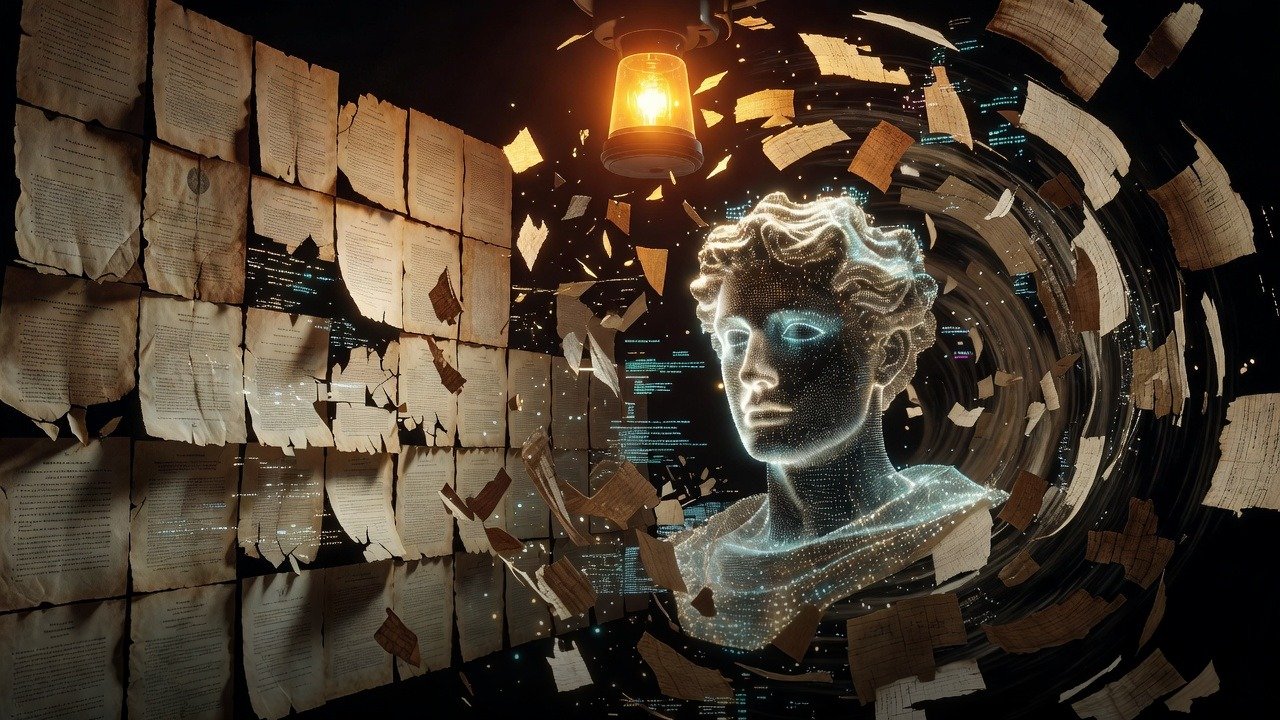
The job is restoration, not casual translation. Ancient Greek writing often has no spaces between words. Damaged papyrus can leave blanks where a scholar needs to reconstruct what plausibly sat there. That work requires more than vocabulary. A specialist has to divide the line, date the fragment, weigh the social and political context, compare reference material, and decide what could honestly fit.
Stephen Colvin, a professor of classics and historical linguistics at University College London, told WIRED that very few people in the world are that good at Greek history.
Apollo is meant to compress some of that specialist context into a tool that proposes likely words or passages for missing sections. Anna Dolganov, a historian and papyrologist at the Austrian Academy of Sciences, told WIRED the model can shift with the source material, using Homeric Greek for Homer and Doric dialect for Doric inscriptions.
The product shape matters. Apollo is not being pitched as an automatic publisher of reconstructed ancient texts. The safer version is a machine that offers options for scholars to review. Armand D'Angour, a professor of classical languages and literature at Oxford, told WIRED that if a machine could offer three possible words for a gap, it would speed the work considerably.
Sail Reply partner Dimitris Vlitas told WIRED that unlocking knowledge this way was unthinkable a year ago. Treat that as partner framing, not a measured benchmark. The grounded claim is narrower and still interesting: a specialized model trained on historical Greek is being offered to academics as a chatbot for fragment triage and candidate gap-filling under expert control.
Why it matters
Apollo is a small story about ancient documents and a bigger story about AI governance.
First, specialist data can beat general model swagger. Six hundred million historical Greek words is tiny next to web-scale training, but it is dense for this domain. The bet is that a model tuned to manuscripts, papyri, inscriptions, dialects, and registers can outperform a general assistant pretending to be a papyrologist.
That lesson travels. Law firms, hospitals, libraries, agencies, and research teams should not bolt a generic chatbot onto a sensitive archive and call it expertise. The corpus, interface, and review loop have to match the real document problem.
Second, gap-filling is not just a product feature. It is a policy problem. A model that completes missing text is generating probability-weighted suggestions. If those suggestions move into an edition, database, catalog, legal file, medical note, or compliance record without labels, the tool can pollute the very record it was supposed to clarify.
Apollo’s reported design points toward the safer pattern: propose options, keep the scholar responsible for the final reading, and avoid silent overwrite of primary material. Dolganov’s warning is the product requirement. Human competence has to remain. Total reliance on AI transcriptions and interpretations is where the problems start.
That is not only a humanities issue. The same control problem appears in medical summaries, incident reports, legal drafting, insurance reviews, and internal knowledge bases. If AI proposes language for a system of record, teams need provenance, labels, review steps, and a clear answer to who signs off.
Third, the realistic upside is volume, not mythology. Colvin pushed back on the public fantasy that AI will suddenly surface a pile of lost Sophocles plays. Many unrestored papyri are ordinary by design: personal letters, marital contracts, civil service paperwork. One scrap rarely rewrites history. Thousands of better-read scraps can sharpen what we know about daily life, institutions, bureaucracy, and assumptions in the ancient world.
That is a better win condition than pretending Apollo is a time machine.
WIRED also reports that Vlitas sees the same technique extending to Latin, Egyptian, or other corpus-heavy fields if Apollo works. That is a roadmap claim, not a shipped result. Still, it sketches a useful category: domain models for damaged or specialized archives where the machine suggests candidates and experts make the call.
Who should care
Classics and digital humanities teams should care if they have fragment backlogs and limited expert time. Apollo’s practical value is faster triage and better candidate readings, not scholar replacement.
Archive, museum, and library teams should care because this is a better pattern than generic chatbot search over scans. The useful pieces are the domain corpus, reviewable suggestions, and provenance rules.
Professional AI builders should care because Apollo is a cleaner product lesson than another broad assistant launch. The job is specific. The user is expert. The output is record-adjacent. The system should not silently auto-commit.
Research integrity and compliance teams should care because generative text is moving closer to official records. The important questions are basic: what was original, what was damaged, what was model-suggested, who approved the final reading, and how uncertainty was preserved.
What to watch next
The key benchmark is not whether Apollo sounds fluent. It is whether scholars get better candidate readings faster while uncertainty remains visible.
Watch the workflow details. Does the tool return multiple options or one confident answer? Does it mark uncertainty? Can a scholar inspect why a fill is plausible? Are model-suggested restorations labeled in editions and databases? How often do plausible fills turn out wrong? Does performance shift across genres, periods, and dialects?
Those details decide whether Apollo becomes infrastructure for scholarship or a demo that creates cleanup work later.
Bottom line
Apollo is a specialist Ancient Greek model for damaged papyrus work, not a magic machine for rewriting antiquity. The honest promise is faster scholarly triage and better candidate fills for fragments that still require human judgment.
The policy lesson is bigger than papyrus: when AI proposes text for a record, the interface has to preserve provenance, uncertainty, and accountability.
Bandwagon Check
**Fairly hyped as a specialist Ancient Greek LLM for fragment triage and candidate gap-fills with human selection; overhyped if framed as a time machine that will suddenly surface lost masterpieces or rewrite antiquity w
Sources
- A New Chatbot Wants to Unlock the Secrets in Tattered Ancient Greek Records
- A New Chatbot Wants to Unlock the Secrets in Tattered Ancient Greek Records (WIRED)
By Sean Smith · AI Bandwagon